Month: August 2020

  • Up a Tree

    Up a Tree


    “The true meaning of life is to plant trees, under whose shade you do not expect to sit.”

    – Nelson Henderson


    When this season of panic/pandemic is a memory, I will sit in the shade and tell of the time when I was “up a tree”.  “Up” is an exaggeration, as is the size of the shade, since the trees I mention are still saplings. But they have taken root and produce green evidence of life so I will start the story now.


    Our Delaware yard was not treeless before we arrive, far from it. A giant white oak shelters birds and shades our deck. in a neighborly way. There’s a tall sugar maple that extends its welcome over the fence to the right, backed up by sky-touching white spruce. Then there’s the black walnut tree that dominates three yards with its green assault weapons. Several branches loom over the back fence and Hannah dodges the rain of walnuts to do her business. I check their whereabouts after every storm. As Frost wrote, something there is that doesn’t love a wall.”  It’s only a matter of time.


    So, all our trees are borrowed.  I start to read Isaiah as the quarantine descends and when I reach Isaiah 55:12 “For you shall go out in joy and be led forth in peace; the mountains and the hills before you shall break forth into singing, and all the trees of the field shall clap their hands,” I realize what I need to do. Plant trees. I want to hear clapping when the all clear signal comes.


    I get stern instructions from Wangari Maathai: “Until you dig a hole, you plant a tree, you water it and make it survive, you haven’t done a thing. You are just talking.” That sets me on a search for what might survive the old black walnut toxins in the soil.  I plant three redbuds to redeem the disheveled shed of our Walnut neighbors.  A cherry tree takes root where it may throw shade in all the right ways. I have no idea how beautiful a crepe myrtle will be, but I like the sound.


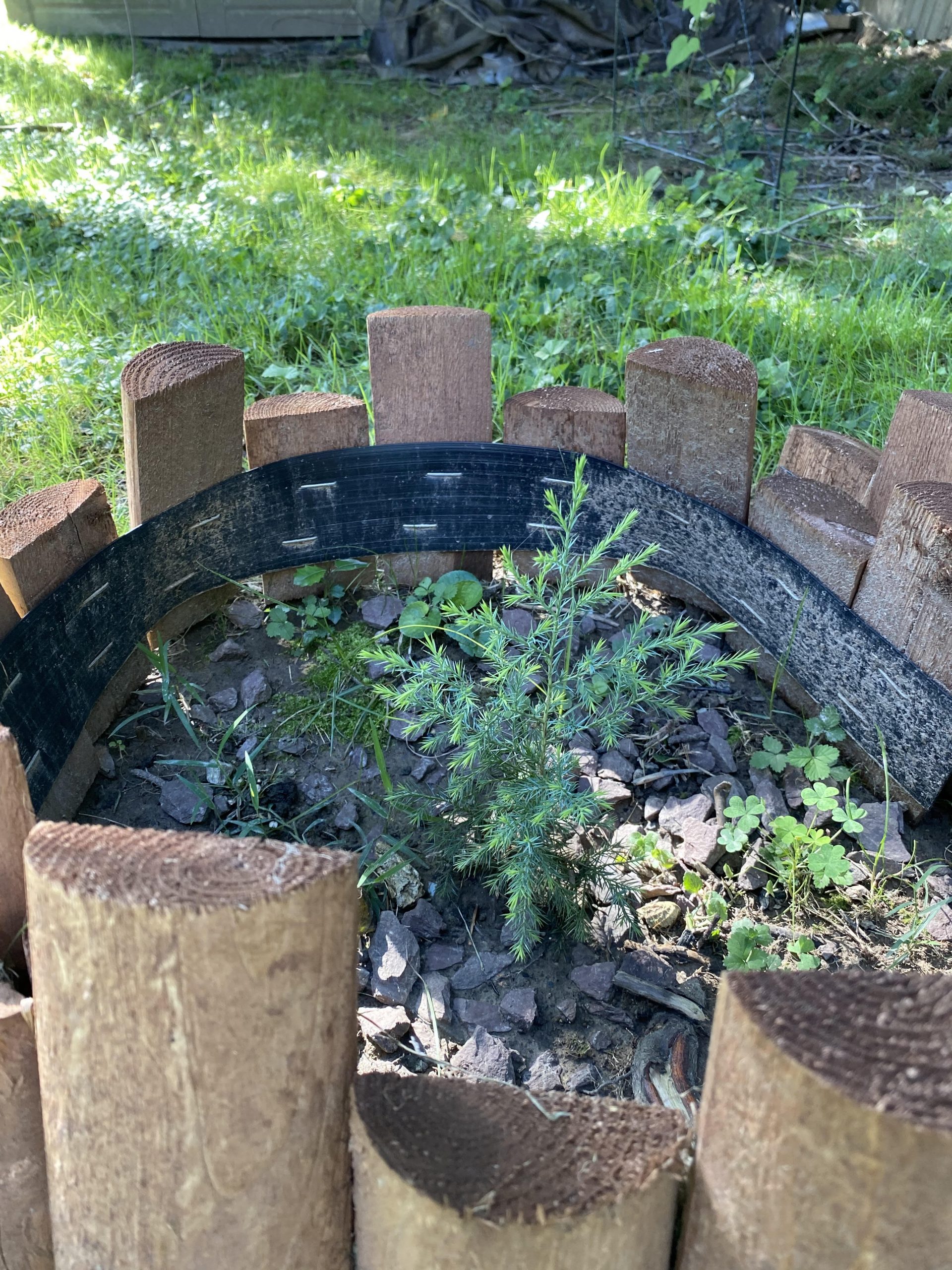
    An unexpected tree presents itself to the search. I find an Eastern red cedar struggling to survive in a crack by the trash can. I transplant it and visit every morning to celebrate its green immigrant life. I now have a trove of trees, a rooted treasure according to Martin Luther: “For in the true nature of things, if we rightly consider, every green tree is far more glorious than if it were made of gold and silver.” Martin Luther. I count the trees like coins:

    • Red cedar
    • White oak
    • White spruce
    • Silver maple
    • Cherry
    • Redbud
    • Black walnut


    I unearth a Bristlecone Pine seed germination kit in a can, saved from a trip to Ellis Island 14 years ago. A Bristlecone is one of the earth’s most ancient living organism. This pine can “make its home in an extremely hostile environment, but also its astounding longevity and amazing hardiness makes it perfect for ornamental planting in a diverse range of climates”. I consider the invitation: “Grow a Tree: world’s oldest living thing.” Should I add to my treasury of trees?


    I decide to wait until another season when there are immigration laws that honor Ellis Island and all those transplanted lives that help to green this nation. The ecology of trees makes the political personal.  “A nation that destroys its soils destroys itself. Forests are the lungs of our land, purifying the air and giving fresh strength to our people.” Franklin D. Roosevelt


    I swear I can breathe easier now.  “Trees exhale for us so that we can inhale them to stay alive. Can we ever forget that? Let us love trees with every breath we take until we perish.” Munia Khan.   With every breath, then. Every breath.
     

  • Untitled post 398


    It’s a first date disaster. It began with a phone invitation to a place I have on my wish list: Ghost Ranch. The caller reminds me that we’d met at a friend’s house, and that he’d seen a play I’d written that was produced at the University of Arizona.  After a pause he asks if I want to go to a party. I remember him. In fact, our first meeting was difficult to describe, plus, I have less than 2 hours to get ready. Nevertheless, I accept the offer. Ghost Ranch makes it all worthwhile.


    Having to climb in the driver’s seat to steer while he pushes his old blue VW to jumpstart the engine didn’t dampen my party spirit. Ghost Ranch, a desert dream of mystery, wealth, and legend. I have to move a green book from the passenger side. It’s stuffed with notes, Tractates Logico-Philosophicus, and the spine’s been mended. I have to ask. His answer covers the distance we travel through the desert, starting with the explanation about the relationship between language and reality, and science somewhere in the middle. I did appreciate the notion that the “limits of my language are the limits of my world”, although I have to guess at the speed limit since the speedometer was broken.


    As we pull up to the entrance I’m  startled by the gun-bearing guard, but Bill casually gives the name of the band leader, George Hawke of Dusty Chaps and we’re waved in. I’m grateful that’s it’s gotten dark, and that there’s a convenient incline to park on. I didn’t want to have to be pushed into gear parked beside the Mustangs, Corvettes, and Jaguars.


    I can hear the band and the exuberant sounds of a pool party inside the high adobe walls. It was like jumping into the deep end when we walk through the gates. Three thoughts immediately test the limits of my language. One, there are armed men sitting along the adobe walls that enclose us. Two, I’ve never seen so many wet naked bodies, ever. Three, I’m definitely overdressed.


    A waiter, also overdressed, asks what I want to drink. I don’t remember my answer. I’m spellbound by the game of naked water chicken. Bill makes a beeline to the band, now on break, then comes back to ask how I want my steak. I check for any signs of discomfort with the surroundings but it’s as if he doesn’t notice the background, just wants to know if I caught the lyrics to the last song they played.


    When he departs for the steaks, I stand, clutching a glass and wondering when the police are going to show up and arrest everybody. Alcohol is the least addictive item on the menu. I don’t want to end up a victim in a hail hell of bullets. Getting ghosted at Ghost Ranch wasn’t my idea of a good time. Months later, the news breaks that the sheriff’s department is on the Bonanno Family payroll. Those armed men sitting on the walls are the law.


    I think about my options. Calling a cab isn’t one. I decide to try to blend in with the band fans, most of whom are still dressed and dry. On my way I’m accosted by a very tall, very blond, very wet, very naked, very stoned man who loudly demands to know, “Who says God is a dog? Who says God is a dog?”  I think he literally spits out the question or maybe he’s just dripping on me.


    That was it. My seminary days will be years in the future, but bad theology, aggressively delivered is my bottom line. Bill arrives with the steaks, and I say, “I want to go. Now.”


    He takes it well. just asks me to hold the steaks while he gets the engine going. In the silence, I’m thinking about another Wittgenstein piece of wisdom “If a question can be framed at all, it is also possible to answer it.”


    I can’t begin to frame a question, but Bill can. Which part of Dante’s Divine Comedy do I prefer: Hell, Purgatory, or Paradise? Thinking of my recent experience, I say, “Purgatory”. That gets us to Milton’s Paradise Lost, and then the character of Satan, and I listen to a brilliant commentary and wonder if I’ve finally met an alien.  This, I think, is definitely a first and a last encounter.


    Then, as we begin our descent into the valley, he shifts a gear, rolls down the window to catch the midnight smell of sage, takes my hand, and says, “Tell me a story.”   And so it begins.


  • The Writing’s on the Wall

    The Writing’s on the Wall


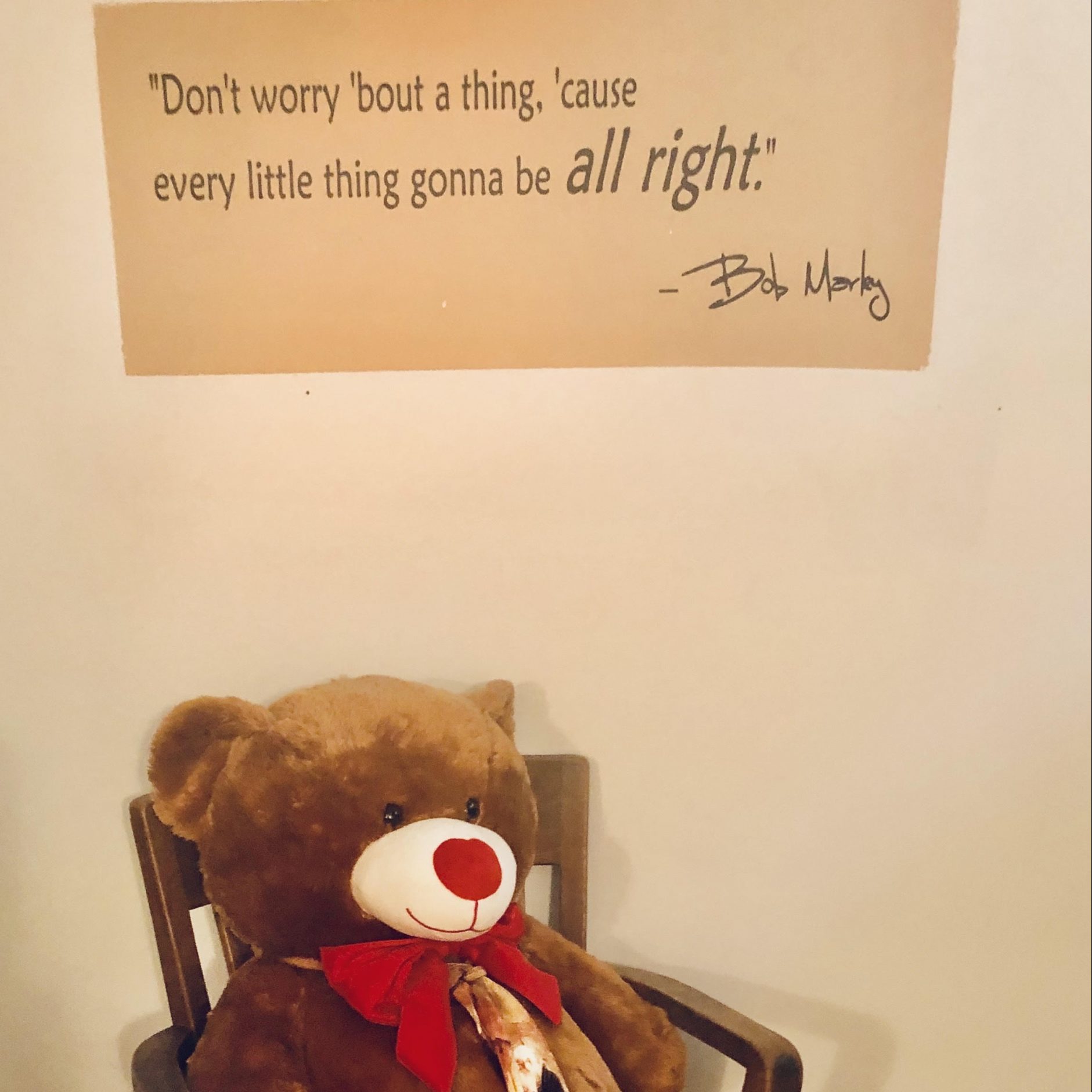
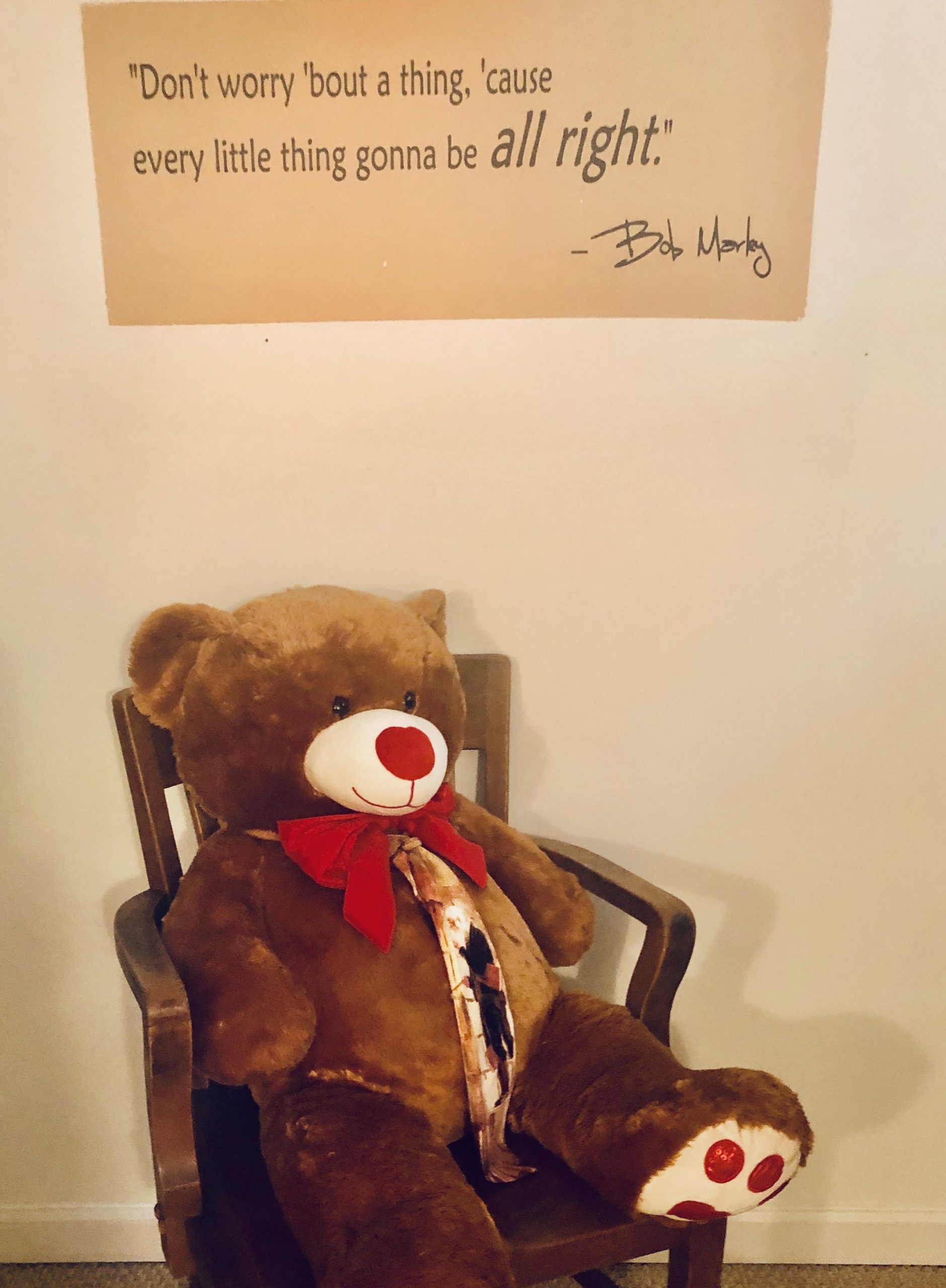
    Our days in Delaware begin with a grand view, a three story farmhouse built on the last rise before the slope leading down to the river. You can’t see the river now, due to neighborhoods built after the wars. Farm land was drawn into a village, and then a suburb, and then absorbed into a city.  We settle into a finished basement that had once been a dream space for teenagers. It’s got a big screen, a projector, leather theater seats, lighted movie posters, a real popcorn machine, as well as a small kitchen, a bedroom and a bath.


    Dr. Who, Guardians of the Galaxy and Lion King posters decorate the space and date the previous owners’ life style and ages. One wall facing the mirrors features another art form; words of a song written in long hand:

    “Don’t worry ‘bout a thing, ‘cause

    every little thing gonna be all right.”      Bob Marley


    I reflect on this text reflected in the mirror while brushing teeth and hair as the tune blows through. Handwriting on the wall usually means a premonition about failure or disaster. Is this description or invocation? Truth or fiction? Every thing? Every little thing?  When, when is it gonna be all right, or even a little bit right?


    My hermeneutic of suspicion calls up another tune/text that gets mixed with Bob Marley.

    “And the sign said: ‘The words of the prophets are

    Written on the subway walls and tenement halls

    And whispered in the sound of silence.’”

    Bill is critically ill; it’s a primary motivation for our move to Grandview. As the pandemic rolls in, and the circle of life gets smaller, he contextualizes the writing on the wall.

    “So, I am forced to cope: frequent hand washing, and limited demonstrations of affection. From time to time I fear I have become what I used to criticize in my English relatives. I’ve become distant, cool, and protective of social space (class). It is entirely possible that the English side of my DNA did not recognize social distancing, since they were never really that close.

    In these circumstances we are, without volition, in this together. So, though I regret these sacrifices, they are ones I am willing to make in order to “flatten the curve” of infections. Yet, my sacrifices are not as altruistic as I hope they appear. I pray that hospitals with limited capacities be spared the crush of infections that attends a pandemic, permitting adequate resources and time for those that do become ill.

    I am also hoping that, if and when that someone is me, there will be space and enough resources. So, when I feel a sense of altruism about being in this together, I know that I’m praying I won’t get stuck in the crush of traffic on the way to the hospital. I don’t want to discover that the only bed available is in the back of my truck and the only help comes from an exhausted nurse tasked to triage the old with “prior conditions” to the back of the line as the parking lot loudspeakers play Marley. “Don’t worry about a thing, ‘cause every little thing is gonna be alright.”

    Reading this reduces me to silence.  Even the silence is underscored by the sound of words written on a wall in the book of Daniel: “Meme, meme, tekel, upharsin.”  It’s one of two Aramaic sayings that I know. “You/we have been numbered; We/you were weighed. You/we are/will be divided because we/you have been found wanting.”


    Weighed and found wanting. The writing on the wall. But then, but then I remember the story of Bob Marley’s song, Three Little Birds. Bright little birds came to his window. Three small birds, feathered like angels, would visit his house on Hope Road every morning.

    (photo by Lon Oliver)

    Hope Road. If you live on Hope Road, every little thing is gonna be all right.  This is the word of the prophet written on the basement wall.  This is evidence that only those who live on the horizon of Hope Road can read: ”Now faith is the substance of things hoped for, the evidence of things not seen.”


  • The Mystery of the Trinity; Or Being at sea with Augustine

    The Mystery of the Trinity; Or Being at sea with Augustine


    The Trinity is a classic conundrum for theologians. How do you explain the mystery in a way that doesn’t mystify?  Augustine is struggling with that problem as he walks by the seaside, taking a break from his writing, On the Trinity.  He notices a small child digging in the sand with a seashell. The child is pouring water from the sea into the small hole in the sand.

    Curiousity stirred, Augustine finally asks what the child is doing. “Putting all the water from the sea into the hole”, was the quick answer. Perhaps Augustine is kind, but he makes his critique clear. Sea=big. Hole=small. Effort=pointless.

    The child listens, smiles, and answers. “Indeed, but I will draw all the water from the sea and empty it into this hole before you will succeed in penetrating the mystery of the Holy Trinity with your small mind.”  Point made, the child disappears.

    I like a legend that upends the hierarchies of age, and education, and priviledge.  This particular one can be traced to a 13th century collection of saints’ lives by Jacobus De Voragine, Golden Legend . Jacobus was a Dominican scholar of Augustine, and his reading audience was Dominican preachers known for their storytelling. The seaside story is added to the collection when it’s translated into English. Its“truthfulness” is based on scene painted on an altar in Antwerp. Oh, the dangers of mixing art and theology!

    Such is the stuff of legends. As we tread water in the here and now, surrounded by sinking ships of state,  I offer this triune reflection. It’s best to count on one’s fingers when trying to make things add up. This teaching is designed for children and those wise enough to trust in mystery.


    Psalm 139

    Holy One,  Holy Three, you have searched me and known me!

    You know when I sit down and when I rise up;

        you discern my thoughts from afar.

    You search out my path and my lying down,

    and are acquainted with all my ways.

    Even before a word is on my tongue,

    Holy One, Holy Three,

       you know it all together.

    You pursue me behind and before,

    and lay your hand upon me.

    Such knowledge is too wonderful for me;

       it  is high, I  cannot attain it.

    Three is One and One is Three,

    Raise two fingers, thumb on “three” then shift to index finger on “one”

    And the One in the middle created me. (point to heart)

    Where shall I go from your spirit?

    Or where shall I flee from your presence?

    If I ascend to heaven, you are there!

    If I make my bed in Sheol, you are there!

    If I take the wings of the morning

       and dwell in the uttermost parts of the sea,

    Even there your hand shall lead me,

       and your right hand shall hold me.

    If I say, “Let only darkness cover me,

    and the light about me be night,”

    Even the darkness is not dark to you,

       the night is bright as the day;

       for darkness is as light with you.

    Three is One and One is Three,

    And the One in the middle was born for me.

    (link hands to make cradling gestures)

    For it was you who formed my inward parts,

      You knit me together in my mother’s womb.

    I praise you, for you are fearful and wonderful.

    Wonderful are your works!

    You know me very well;

    my frame was not hidden from you,

       when I was being made in secret,

        intricately wrought in the depths of the earth.

    Your eyes beheld my unformed substance,

       in your book were written

       the days that were formed for me,

       every day, before they came into existence.

    How profound to me are your thoughts, O God!

    How vast is the sum of them!

    If I could count them,

       they are more than the sand,

       when I awake, I am still with you.

    When I awake, you ate still with me.

    Three is One and One is Three,

    And the One in the middle will set us free.

    (Raise arms and open hands on the word “free”.)