Category: Telling the Christian Year

  • The Lamb

    The longest night is coming and it will be longer than we remember, expect, or imagine.

    Sadness has already overtaken us like unforgiving weather.

    The flow of unwept tears and the deluge of floodwaters frighten us all.

    What hope or peace is possible, given how weary we are, soul and body?

    Pull up your chair to the edge of the chasm and I will tell you a story.


    After the first frost, when the nights are growing longer, Navajo families gather in their hogans and the elders would begin their stories. This is a true story about stories.

    I was there, teaching in the 4 corners area, nearly fifty years ago. The stories told between the first frost and the first thunderstorm are origin stories, stories that help a people remember into the future. Tonight, I tell you one of our stories, we who follow the One whose name is Beloved. It is a story for the long nights as we wait for the rising of the sun.

    It’s not an ideal setting for a Christmas play.  A narrow space between a wall of concrete block and the first row of benches serve as the stage. The lighting in the concrete block chapel is simple: on or off. To get there, I have to walk across the open yard of Moundsville Maximum Security state prison, built in the 1800s to hold 400 men. There are over 800 men incarcerated there now, with little to pass the hard time. Thinking back now, crossing that yard with the prison chaplain, without guards, was a fool’s journey.

    Even the costumes were foolish: a football jersey, burlap and twine, scrappy blankets, prison uniforms worn inside out, upside down. The prison regulations prevent me from bringing in “good” costumes.  The cast’s uneven, to say the least. One actor claims a masters.  One cannot read, and has to learn his part, line by line, recited by a buddy two cells down. Less than ideal, more eloquent than words could convey, this is real life, hard time drama.

    A blanket with holes is a cause for complaint. A ragged shepherd’s cloak, however, is a good thing. A prison yard is a desolate place, spare of grass, and grace.  A prison yard is an ideal Bethlehem scene with greying walls of stone, hard ground, and the smell of occupation. No need to imagine a cast of Roman guards.  They remain in place on the walls, keeping watch over their flock by day and by night.

    “In the beginning was the Word . .,” and that’s the problem.  I can’t find a Christmas script that fit.  What works in a Hallmark Christmas Eve does not work here.  A maximum-security prison is world on its own, needing a language as brutal and sophisticated as its own life, or, as one of the guards explains it, “My perception is your reality.” or as the sign on the exit door reads “This is prison, not Burger King. We do not do things your way.”

    From an assignment in sophomore English I recover “The Second Shepherd’s Play”, a medieval genre named, aptly enough, a mystery play.  Composed in a time when shepherds stood one step above slavery and one foot outside the law, it’s got a familiar ring to men who recite a number before they say their name.  The rhymed couplets are a bit much, though the yard rap works its own charm on the lines.  We decide to call our version, The Second to None Shepherds’ Play.

    I tell them the story.  They listen.  I tell it again. They question, turn it over, check its strength, then, they tell me what they know.  I listen.  Word by word we reconstruct this “make believe” so it belongs to their rough place, their hard time.

    One prisoner is so taken by this “make believe” that he insists on changing the end of the story.   He plays the thief who steals the lamb, disguising himself as a woman in labor.  His disguise works until the shepherds recognize the cry of the lamb, hidden under his makeshift skirt/shirt. Only the arrival of a very pregnant Mary and Joseph saves him from hanging.

    In the original version, the thief disappears as soon as he’s set free, leaving the shepherds to honor the new-born messiah. This particular prisoner insists on a rewrite.  He wants to return the lamb himself to honor the child.  He demands to be allowed to kneel beside the shepherds, not run away.  He refuses to be left “out in the cold’.  When I press for a reason, he says. “This king, this kid doesn’t mind a thief hangin’ round.”

    We need a prop, a lamb small enough to hide under a shirt, yet big enough to resemble an animal.  The theft of this creation is the heart of the play.  I give the assignment like a mission impossible.  Required: one lamb, no questions asked, no prisoners taken.

    It’s ready for inspection the following week. The lead shepherd lays it on the table in the visitation room for inspection and waits for a verdict.  I’m properly amazed.  The lamb consists of: a cardboard box covered with cotton balls (medical supplies?)  ears and tail from a pillow case; a head made from a navy-blue stocking cap (the donor risked temperatures below freezing every day, all day in the yard) and four white socks for legs.

    The socks catch my attention.  They’re brand new.  Prisoners are issued new socks twice a year.  Four prisoners, non-performers, had each donated one sock, so that no one would be short both socks of their pair.

    Every time I cross the yard, I look at the clusters of men in the yard and wonder which four wore one “holy” sock.   The men name the prop, “Chops” and made jokes about its pieced-together appearance.  As weeks of rehearsal pass, I notice they each take turns holding the lamb while others rehearse.  These are grown men, guilty of terrible crimes.  They had stories I don’t want to know.  But the telltale action gives them away, they’re children again, sitting alone, rocking and hugging a long-lost toy.

    Speaking of children and Christmas no child is ever permitted in this violent space.  No doll is allowed through these gates of hell. What do we do about the baby Jesus?

    We practice with an empty manger (cardboard box, shoe-polished sides), but the absence oppresses.  I try to encourage them to imagine. After all, what color skin should Jesus have? The absence of the Beloved Child seems to make the story into a lie, a collapse of “make believe” to reveal there is no Emmanuel, no God with us.

    The answer to our theodicy problem is off the wall.  In the last rehearsal “Mary” looks at the lamb held in the arms of a proudly penitent thief and walks into the chaplain’s office. “He/She” reenters the chapel with something wrapped in a towel. The rehearsal takes on the tension of a “mysterium”, a sacrament.  When the time come, Mary lifts the cloth. A crucifix is cradled in the manger. No one says a word. For the longest time, no one says a thing. then, the men say they’re done rehearsing.

    That night, I wonder how the story will end as we, the cast, the chaplain, and I walk across the open yard past 800 men. Only 40 will be allowed into the small chapel, while others pressed around the windows to look in. As the climax of this curious Christmas story approaches, I study the faces of the congregation. The blanket is lifted, that awful, awe-full power of the story of the lamb of God is revealed in a landscape of trauma, and violence, and loss.   There is silence, and then the soloist begins to sing. It’s not the song we practiced. It’s not Silent Night, but this “Through many dangers, toils and snares, I have already come. T’is grace that brought me safe thus far, and grace will lead me home, “

    “Yet any who did accept the Word, who believed in that Name, were empowered to become children of God, children born not of natural descent, nor urge of flesh nor human will, but born of God. And the Word became flesh and stayed for a little while among us…John 1:12-13

  • Crossings

    Of the many objects I’ve been drawn to over a lifetime, a cross is not one. I’ve sung songs about, admired the art of, told stories about, folded palms to make, and prayed in the presence of, but I’ve not collected crosses. I gift them, handing them on if one presented itself to my keeping.

    I’ve not explored my psychology in any depth, although I’ve devoted a goodly amount of time to cross theologies. A cross, with body and without, feels too awe full and awful, too numinous for close proximity.

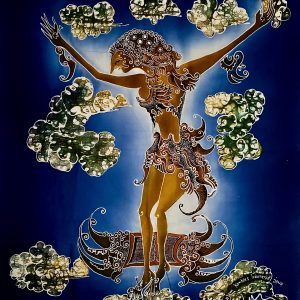
    The events of the last two weeks prompted a search for this tangible symbol of human violence and paradoxically holy resistance and resurrection. It was a gift too precious to give away, a cloth crucifixion crafted by an artist in Indonesia, hand delivered by a Drew alumni, missionary, and friend, Ron Weinbaum.

    Packed among my vestments, the gift rests, and I unfold it as gently as if, as it does hold a beloved body. I hear in the background the sound of women, reporting the news of the violent death of women. There were more than three crosses in Jerusalem. The cross was the Roman Empire’s invention for crowd control. It took time. It was public assault as well as personal torture. An assault weapon does not take three hours to kill; 3 shots per second, yet the loved ones of those lost hang suspended in public agony for years.

    I smooth the royal blue of the sky and sea, gently touch the green islands beneath the wounded feet. There is no cross; the body is suspended by nails against the deep blue of sky and clouds of island green. I know that I don’t know what it all means, just as I don’t know enough of what I should know about those Asian American women whose lives were so violently ended. My vision has been blurred by staring too long into a Western sun.

    What I know is that the cloth is a Javanese Batik, created by Pendetta Aris Kristian Widodo, using a technique that’s over 1,000 years old. Aris creates the concept and lays out the design.  A team of Muslim Javanese artisans completes the work. This image of treeless crucifixion was made in the teak forest outside of Yogyakarta near the famous Borobudur Buddhist Temple. What I do know is the artist has reformed my vision of the cross with this Javanese gospel of dying yet rising life.

    Now hung, this Indonesian crucifixion covers the door that leads to the world outside. How long? I do not know. Perhaps she will tell me. I touch her hand, and pray, “Christe eleison. Mercy, have mercy.”

    See: http://www.facebook.com/ron.weinbaum.9/videos/10156562517855787


  • Who’s Making a List?

    Who’s Making a List?

    It was a curious assignment, even for Heaven. He’s been given a second mission for God. He’d completed his first mission so completely, so thoroughly that his earthly friends insisted on making him a bishop.  If that hadn’t been too much fuss and nonsense, they labelled him a saint long after he had exchanged earth for heaven.


    Saint Nicholas. None of this fuss disturbed his real work of the Galaxy Charity Center. Heavenly hosts pay little attention to human fame. A Turkish bishop known for dropping gold coins in the stockings of the poor isn’t remarkable, but centuries have passed and suddenly there’s a question of a saint’s reputation.


    It’s apparently a problem of fake saints. They’re for hire, wear pseudo-red velvet suits, and removable beards and claim they can fly.  They also shout so loud they frighten children. The worst part of this stolen identity is the fake saints help make the poor poorer and the rich richer.


    Heaven wants a first-hand report and who would be better than the real Nicholas? He doesn’t even need an earthly disguise; his red bishop’s robe will pass for a red velvet suit. A simple wreath of holly berries. a symbol of Christ’s thorny crown, will blend in with season’s attire.


    What should the saint take for the journey? Keep it simple: a shepherd’s staff, and a lantern.  His mission: find out if anyone still knows what Jesus really wants for Christmas.


    In the wink of God’s eye, Nicholas is once again on earth. He sets out walking in the direction of the lights.  The roads are four times wider than the ones he’d once traveled. They’re backed up with noisy 4-wheeled inventions that supposedly used horsepower. The drivers made loud rude noises with trumpets hidden under the metal tops of their chariots.


    Sometimes, however, the chariot riders seem to recognize him. They point excitedly as he walks past and they roll down the windows and wave. Nicholas stops when a little boy shouts at him.  But the name he hears isn’t his, “Santa something” and the request makes no sense. What’s a Xbox?  The saint simply waves and keeps walking.


    He arrives at the small city of lights. It’s not a city, actually, but villages crowded together under one roof. There’s a village named Macy and one called Body Works, and another with Lord & something. Maybe he’ll find the saints there.


    A woman wearing antlers stands at the entrance and greets him with the name the little boy had shouted. “Merry Christmas, Santa.” Christmas, the festival of Christ’s birth he recognizes. The merry part was new. But why not? Saints can be joyful. “And a holy night to you, my sister.”


    Lord & something is a very noisy, busy village. Music’s playing, but no one seems to be listening to the song about the manger and baby Jesus. Everyone seems anxious, rushed, so not at peace. “Peace on earth” the invisible angels sing over their heads, but no one is singing with the angels. Nicolas notices that a man wearing a badge has begun to watch him closely, following him down one of the narrow streets lined with coats while seeming to talk to his hand.


    Just then three boys surround the saint. “Hey, Santa, where’d you park your reindeer?” one demands. “Check this out, a survivalist!” He pulls the lantern up for a closer look.


    “They’ve been drinking”, thinks the Saint. Young men had this problem in his time, too. The third boy is quiet, studying him while the other two rap nonsense about red noses and bowls of jelly. When one tugs on his beard, the Saint puts his crook to good use. The two trouble-makers beat a quick retreat, but the third remains, wary, watching. Something in his face catches the Saint’s attention.


    The old man moves closer. “Is there something you need?”  The boy shrugs, turns away and then back again. His words tumble out, fierce, hot, and bright like coals. “Listen, I don’t believe in Santa. You’re just a stupid joke. But I…you know… you should be… there should be somebody needs to make a difference. You know what I want for Christmas?  Some way to make rent, or get groceries or goddam toilet paper!”


    Now the boy is shouting and the man with a badge moves closer. “We need to keep fed and warm. Write that down on your list, Sam, or Santa, or whoever you think you are!”


    He turns sharply, stomps past the badge guy, pushes by the antler-wearing woman. “On earth as in heaven” the Saint whispers a prayer as he makes his way toward the exit signs, following the boy past the parked chariots.  He keeps his distance down streets that narrow, and between houses that crowd together like they’re trying to keep warm. He stops at the street lamp that’s out at the corner house where the boy enters, and slams the door.


    He’s got his list now, but where are the saints?  Heaven needs good down-to-earth help. Where are the believers on this night of nights?  Perhaps they still meet in homes. Maybe the persecutions which threatened the church in his time are still going on.


    The Saint grips his staff and raises his lantern. The road is dark and comes to a sudden stop at a crossroad. Should he go to the right or left? Where could he find Christians on Christmas Eve? Left, or right?


    He follows his staff that’s leaving left. The streets are quiet; snow begins to fall, but he knows he’s not alone. The light from a large window turns the snow into a rainbow and through the open door he sees the sign he’s been searching for. The Saint lifts his lantern, lighting the way for the boy who’s been following him.


    Once inside they’re greeted with a smell of cinnamon and apples, candle wax and pine. The Saint and the boy are welcomed, offered seats, songbooks, and Christmas cookies. The people are already singing the same songs as the marketplace, but the sounds are much more merry.


    The boy’s shoulders slowly relax, unstiffening as he listens. Some singers have silvered hair and rusty voices, and some sing, holding high notes as easily as they hold children. The Saint smiles to see the stockings and mittens hanging on a tree, waiting for children who need them.


    Whoever these people are, Nicholas decides, they know what Jesus wants for Christmas: human miracles called kindness. They will know how to help the hopeless. The Saint shows the boy how to take the small candle when the basket comes by.  The boy then helps the old woman sitting beside him hold her flame steady. She thanks him in a whisper and asks his name.


    This is how the light happens, Nicholas knows. There’ll be groceries the boy can carry, sidewalks to shovel, errands to run and, somehow, the rent will get paid; groceries begin to materialize, and one day, there will be a chance for the boy to go to school. This is how a list turns into Love: the light is passed, heart to heart and hand to hand.


    Mission accomplished. The Saint can hear the heavenly host join in the earthly chorus: “Silent night, holy night, wondrous star, lend thy light; with the angels, let us sing…”


    Written for those who need a saint, not a Santa.  

    December,1993, revised 2020.

  • A Maundy Thursday Handwashing and Table Service

    A Maundy Thursday Handwashing and Table Service


    Handwashing is an ancient human gesture embedded in daily practice. It can now be a matter of life and death during a time of contagion. We need literal as well as spiritual cleansing in these times. Holy Week scriptures offer us a story of compulsive washing, and a narrative of compassionate cleansing. Pilot, politician of an empire, publicly washes his hands, attempting to shed his responsibility for protecting the innocent.  He attempts to wash his hands of the whole affair.  In contrast, Jesus in the privacy of a home, takes a towel and washes the feet of his friends. That washing immerses them in his ministry, cleanses and empowers them to “do this” for others in memory of him.


    These two stories of washings invite us to baptismal renewal in this week and lead us to a Table. Jesus gathers his friends for a meal when life as they know it is ending. That Supper is a meal of memory and hope: the people pass over, from death to life, from slavery to a promise of freedom.  It is a meal of wonderous love and amazing grace, first offered in a home and then as the church expanded, in sanctuaries.  This can be a time to return to home as a sanctuary again.


    There is a tradition of handwashing in preparation for sharing in a sacred meal. Psalm 26 was once used sung by those who gathered in Jerusalem. Centuries later it was recited by priests preparing to preside in the sacrament of the bread of life.  They would pray these words in silence while preparing by washing their hands.


    I wash my hands in innocence, and go around your altar, O Lord, singing aloud a song of thanksgiving, and telling all your wondrous deeds. O Lord, I love the house in which you dwell, and the place where your glory abides. Do not sweep me away with sinners, nor my life with the bloodthirsty, those in whose hands are evil devices, and whose right hands are full of bribes. Psalm 26: 6-10


    These ancient words include the washing, the coming to the altar, songs of praise, and testimonies to God’s redemptive work. There is a plea for personal safety and a fierce call for justice, all connected to washing and the sacrament of holy communion.


    There is also another Table, the Love Feast, where Christians have gathered to celebrate the presence of Jesus, our brother, savior, friend in testimony, song, praise and praise. A Love Feast traditionally includes a foot washing (hand washing in this service), the greeting of peace; confession of sin, expressions of faith, and praise through songs and testimony.


    This service of washing and the Table offer us hospitality and reconciliation with God and with each other.  A Love Feast can deepen our understanding of Holy Communion if the choice is to “fast” until the community can gather together again. United Methodists pastors should take this opportunity to share This Holy Mystery: A United Methodist Understanding of Holy Communion with their congregations.  If we cannot gather to celebrate Holy Communion in sanctuaries as in the past, this table service offers washing and a sacred meal at home.


    However, sharing on-line communion in homes with a pastor/presider could also be our Wesleyan heritage, particularly given the development of the itineracy as pastoral care in times of great need. Pastors need to keep informed to what their bishop is advising, especially as some bishops have revised their request for a moratorium. The bishops in the Western Jurisdiction write: “Especially in this time of physical separation from one another, Holy Communion can be a conduit of God’s healing power. We remain open to what God is teaching us in this moment. We believe in the importance of being community, present together at the Table of our Lord, repentant of our sin and seeking to live in peace with one another.” see http://www.calpacumc.org/news/western-jurisdiction-bishops-offer-guidance-for-the-observance-of-holy-communion.


    There are conduits and channels of grace through live-streaming, Zoom, or phone. Printed materials for this service can be mailed or emailed to members.  One essential reminder for any service at home at this time: one person can be a household, sheltering in place. Some liturgical settings are suggested, but a kitchen sink, a candle, towel, table, water, oil, and food are the only things required. This service is designed to be a spiritual exercise for one individual, or two or three gathered together, as well as a pastor connected to others via digital means.


    Maundy Thursday Hand Washing and Table


    Begin the service by lighting candles as the words are read.


    L: Blessed are you Holy One, our God, Creator of the universe.

    You form light and create darkness, make peace, and give life to all things. Isaiah 45:7


    Welcome (those at home or/and on-line)


    Song or reading 


    Prayer for Purity

    Almighty God,

    to you all hearts are open, all desires known,

    and from you no secrets are hidden

    Cleanse the thoughts of our hearts

    by the inspiration of your Holy Spirit

    that we may perfectly love you

    and worthily magnify your name,

    through Christ our Lord.  Amen.


    Silent Reflection


    Song of Assurance of God’s Love


    Pilate’s Basin

    This can be an antique pitcher with basin on a small table or a pitcher at the kitchen sink. The water is warm. There is scented soap with good hand towels, one for each participant. Children can help by handing out the towels. These words are said, “Remember, only Christ can wash away our sin.” One person pours the water as each in turn washes their hands. The Doxology or a song of praise can be sung during the washing and drying of hands.


    Baptismal Renewal Basin

    After this washing, move to a second pitcher and bowl at one end of the dining table. The pitcher/container could be clear glass and hold anointing oil or plain olive oil. The words are: “Remember, you are baptized and anointed by the Holy Spirit.” An individual will say, “Remember, I am baptized and anointed by the Holy Spirit.” After the oil is poured into each person’s palms held over the basin, they touch their own forehead, their heart, or smooth the oil into their hands saying, “Thanks be to God”.


    The Servant’s Basin

    The third pitcher and basin should be well-used, and the towels should be kitchen towels. The water in this pitcher is cold. Water is poured into your open hands with the words, “Do this in memory of the One who did this for you.”  The individual would say, “I do this in memory of the One who did this for me.” The group response is, “I will remember.” You are invited to use the towel as napkin and a symbol of service.


    If it’s a service of Holy Communion, the on-line presider/pastor can begin the Great Thanksgiving, leading the prayers while those at home are at table with individual cups and bread. Using an ordinary coffee cup for communion can “altar/alter” its meaning by lifting up the commonplace for holy use.  The Epiclesis, prayer for the Spirit may be prayed in union with the presider.  This is the prayer of those baptized by water and the Spirit; its language is plural; it binds the whole body of Christ into service.


    L: Pour out your Holy Spirit on us gathered here,

    and on these gifts of bread and wine.

    Unison:

    Make them be for us the body and blood of Christ,

      that we may be for the world the body of Christ,

      redeemed by his blood.


    By your Spirit make us one with Christ,

      one with each other,

      and one in ministry to all the world,

      until Christ comes in final victory,

      and we feast at his heavenly banquet.


    If the Table is a Love Feast celebrating Christ and the priesthood of all believers, the food that you find comforting should be shared. A reading from scripture or the Covenant Service can be done before eating. The sharing of recipes and stories, along with favorite table graces follows. Invite those present to respond to the question: “What does it mean to me to serve Christ?”


    Christ has many services to be done.

    Some are easier and more honorable,

    others are more difficult and disgraceful.

    Some are suitable to our inclination and interests,

    others are contrary to both.

    In some we may please Christ and please ourselves.

    But then there are other works where we cannot please Christ

    except by denying ourselves.

    It is necessary, therefore,

    that we consider what it means to be servant of Christ.[i]


    “Directions for Using a Towel” can be used as meditation on the meaning of the hand towel or as a closing reading before the benediction.


    Directions for Using a Towel


    To be used for:

    Drying dishes.

    Wiping eyes.

    Mopping spilled milk.

    Coping with sighs.

    Cleaning stains.

    Creating scandal.

    Holding on when it’s too hot to handle.


    Washing feet.

    Softening jars.

    Binding wounds in a world of scars.


    Better than Bounty, thin as skin.

    Don’t give it up, or throw it in;

    It simply grows more holy over time.


    For when the One

    that death could not defeat

    arrives,

    the towel will be our sign.

    All grave and dusty sins are washed away.

    God takes us by the hand and helps us rise.[ii]


    Table Fellowship


    Blessing


    [i] Wesley Covenant Prayer adapted by Heather Murray Elkins ©2002 The Holy Stuff of Life, all rights reserved.

    [ii] Ibid.


    [i] Wesley Covenant Prayer adapted by Heather Murray Elkins ©2002 The Holy Stuff of Life, all rights reserved.

    [ii] Ibid.

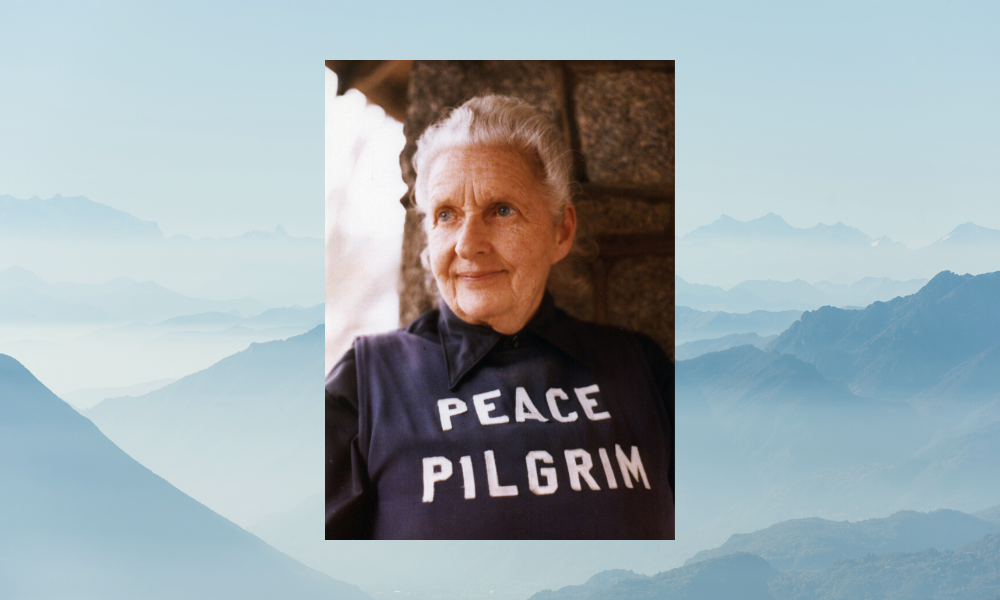
  • Peace Pilgrim

    Peace Pilgrim

    Epiphany offers us the ancient story of starlight and wise men from the East who once traveled to honor the Prince of Peace. This is a personal story of an encounter with Peace Pilgrim, a woman once considered anything but wise. It is shared as a witness to her and to all who work for peace and good will in this world.

    Matthew 2: 1-12

    https://www.youtube.com/watch?v=7Xfkc8dHWBY
  • Imagining the Magnificat

    Mary’s song, the Magnificat, has inspired artists, activists, believers in many faith traditions for centuries. This visual reflection features the sculpture of Charles McCollough and the poetry of Maren Tirabassi. This is the season to rejoice in the Holy One who lifts the lowly and fills the hungry with good things.

    Luke 1:46b-55

  • Advent or Adventus: Christ or Caesar

    “Do you know what time it is?”  That is the insistent and persistent question of Advent, regardless of the color of candles or number of Sundays. The scriptures press this question with urgency. Wake up. Someone is coming. How you prepare for that arrival will depend on who’s coming and if you believe everything depends on your answer.       

    Romans 13:11-14